 Kashmir family tour packages
 Amarnath Yatra guide
 One booking for stay and cab
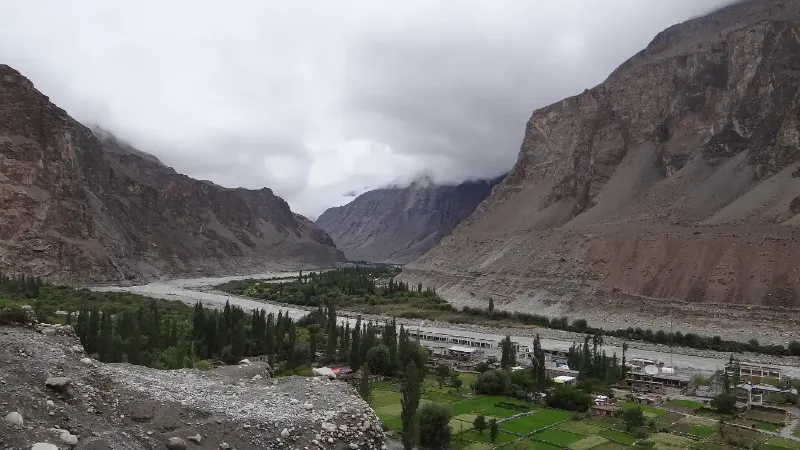
Turtuk is the last village on the Shyok river before the Line of Control, about 205 km from Leh. It was opened to visitors in 2010 and is different from the rest of Ladakh in almost every way: the people are Balti, the language is Balti, the fields grow apricots, buckwheat and barley at a lower altitude of about 2,900 m, and the houses are stone and wood around narrow lanes. For travellers already going to Nubra, it adds one unforgettable day.
Getting there
From Leh the road crosses Khardung La (about 5,360 m) to the Nubra valley, passes Diskit and Hunder, then follows the Shyok west for about 90 km to Turtuk. Total driving time from Leh is 7 to 8 hours, so the standard plan is Leh to Hunder on day one, Hunder to Turtuk and back or onward on day two. See our 7-day Leh, Nubra and Turtuk tour, which gives Turtuk a full day, or the 8-day Srinagar–Kargil–Leh plan that includes it.
Permits
- Indian citizens: Inner Line Permit for Nubra with Turtuk and Thang specifically listed. Issued online or at the DC office in Leh; we arrange it for guests on our packages.
- Foreign nationals: Protected Area Permit through a registered agency in Leh.
- Carry several photocopies of the permit and your ID; check posts at Khalsar, Hunder and before Turtuk keep a copy.
What to see in Turtuk
Youl and Farol
The village has two main parts joined by a footbridge over the stream: Youl, the lower part near the road, and Farol on the plateau above. Walk through the lanes of Farol in the morning; the stone channels carrying glacier water through the village are the oldest engineering here.
Balti heritage house and museum
A family-run museum shows traditional tools, dress and the history of the Yabgo rulers of the area. Small entry fee.
Natural cold storage
Stone cellars under the village stay cold all summer and are still used for butter and meat. Ask your host to show one.
Thang viewpoint
A short drive beyond Turtuk, Thang is the last Indian village and the furthest point visitors can go. The army viewpoint looks across to posts on the other side. Permit and ID checked; no photographs of the post itself.
Apricot orchards
Turtuk apricots are famous across Ladakh. Harvest runs through July and August; dried apricots and apricot oil are sold in the village all year.
Add Turtuk to your Ladakh itinerary
Share your dates and group size. Our Srinagar team calls back with a day-wise plan and a clear price.
WhatsApp usWhere to stay and eat
Homestays and small guest houses in both parts of the village; most include dinner and breakfast of Balti dishes like kisir (buckwheat pancakes) and apricot-based sweets. A few camps sit by the river. There are no large hotels, and power can be limited to evenings.
Best time to visit
- May to June: roads open, blossom gone, green fields, clear mornings.
- July to August: apricot harvest, warmest months, occasional rain on the Shyok road.
- September: clearest skies, harvest of barley and buckwheat, cooler nights.
- October to April: Khardung La and the Shyok road can close; most homestays shut.
Know before you go
- Turtuk is lower than Leh, so most people feel better here; still, you cross Khardung La to get in and out.
- Cash only. The nearest ATM is in Diskit and it is not reliable.
- Mobile: postpaid Indian SIMs work patchily; prepaid SIMs from outside Ladakh do not work.
- Dress modestly and ask before photographing people; this is a conservative Muslim village.
- Fuel up in Diskit; there is no petrol pump in Turtuk.
- Carry your permit at all times, including on walks around the village.
Frequently asked questions
Distance from Leh?
About 205 km, 7–8 hours; break the trip in Hunder or Diskit.
Permit?
Inner Line Permit (Indians) or Protected Area Permit (foreigners) with Turtuk listed.
Best time?
May to September; apricots in July–August.
Where to stay?
Homestays and small guest houses in Youl and Farol.
Thang viewpoint?
Yes, a short drive beyond Turtuk with permit and ID.
Photo: Rajnish71, CC BY-SA 4.0, via Wikimedia Commons (cropped).